4 February 2026
In July 2024, the Ecodesign for Sustainable Products Regulation (ESPR) entered into force as a key component of the 2020 Circular Economy Action Plan and of the EU’s efforts to create a single market for sustainable products.
Its goal is to significantly improve the sustainability of products placed on the EU market by enhancing their circularity, energy performance, recyclability and durability.
Like its predecessor, the Ecodesign Directive 2009/125/EC, the ESPR establishes a framework for setting ecodesign requirements for specific product groups, but goes further on two dimensions:
- It significantly extends the scope of products covered, from energy-related products only to virtually all products, with a few exceptions such as food and feed, and medicinal products.
- It widens the range of ecodesign requirements, now covering durability, circularity, reusability, resource efficiency, and the reduction of climate and environmental impacts.
Alongside these ecodesign requirements, three additional measures stand out.
- The Digital Product Passport (DPP) introduces a digital identity card for every product, final and intermediary, storing relevant information on sustainability, circularity and legal compliance, including technical performance, materials and their origins, repair activities, recycling capabilities and lifecycle environmental impacts.
- Rules addressing the destruction of unsold consumer products mark a major shift. The EU will ban the destruction of unsold textiles and footwear initially, with the possibility of extending the ban to other sectors. In addition, large and medium-sized companies will be required to disclose how many unsold products they discard and why.
- Finally, Green Public Procurement will become mandatory, requiring public authorities to apply sustainability criteria when purchasing products and services.
ESPR: yet another acronym for another administrative burden?
As with many new or updated regulations, the ESPR may be perceived as a compliance-driven exercise. However, it introduces a holistic approach to product sustainability, centralizing information and performance requirements under a single framework.
In doing so, it aligns with initiatives such as CSRD, CBAM, the Green Claims Directive, ECGT, REACH and the Packaging and Packaging Waste Regulation (PPWR). The Digital Product Passport is intended to serve as a single electronic source of information, enabling stakeholders across the value chain to make informed decisions on sustainability, circularity and regulatory compliance.
What is coming next?
The European Commission has adopted the first ESPR and Energy Labelling Working Plan, identifying product groups and transversal measures to be prioritized between 2025 and 2030. It includes four final product groups (textiles/apparel, furniture, tyres and mattresses) and two intermediary product groups (iron & steel and aluminum), as well as two horizontal requirements: repairability and recycled content/recyclability.
This comes on top of the 35 energy-related products already covered under the previous Ecodesign Directive, to which ESPR requirements will also apply. The first delegated acts are expected from early 2026 and will define sector-specific requirements, including Digital Product Passport data, following impact assessments and stakeholder consultations.
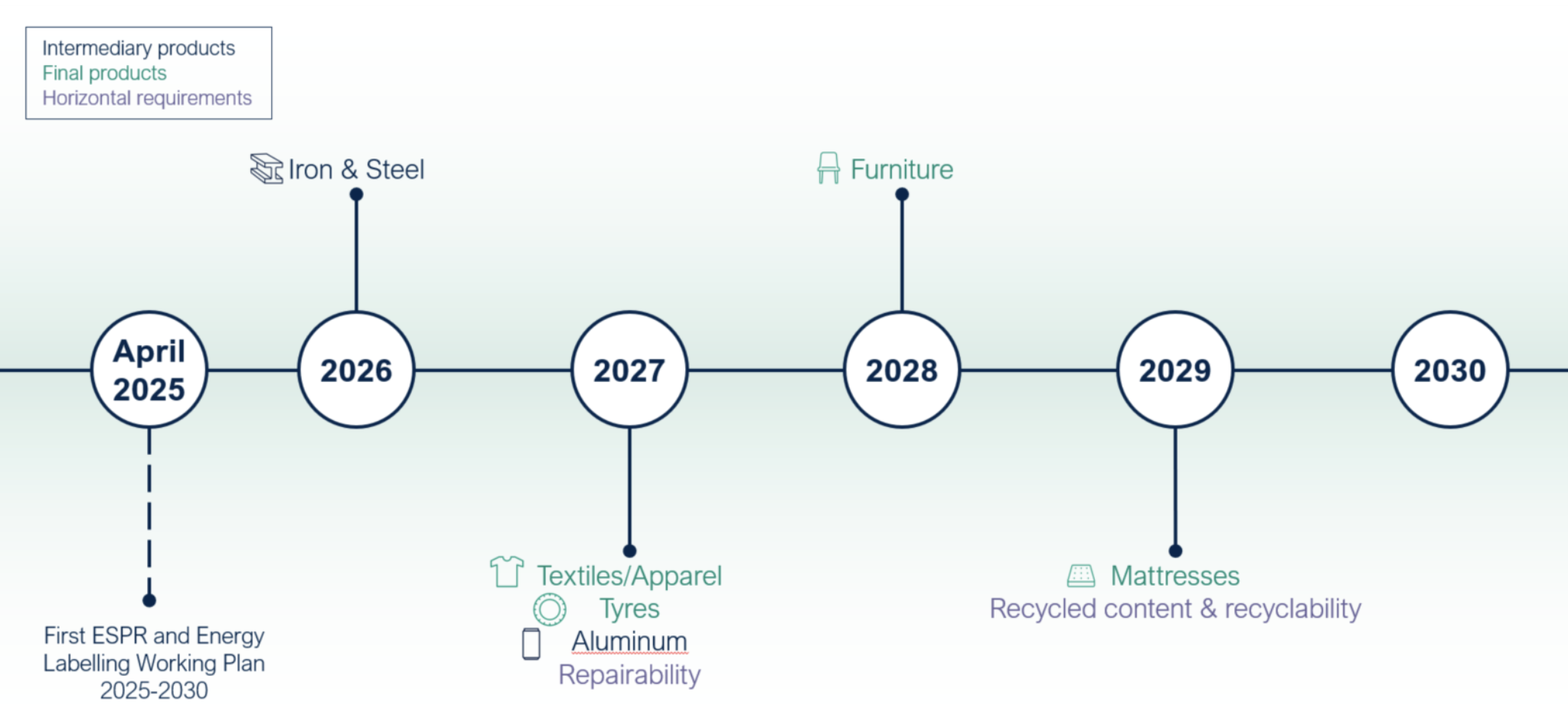
The first delegated acts are then expected as of early 2026 and will formalize, for each sector, the specific Digital Product Passport data requirements, building on the general principles set out in the ESPR and following detailed impact assessments and stakeholder consultations.
How to turn ESPR into an opportunity for your business?
While some may see the ESPR as adding complexity, it represents an opportunity to shift sustainability from a compliance or marketing exercise to a core business strategy. Companies positioning themselves early in the emerging sustainable EU market can leverage existing initiatives or launch new ones to secure competitive advantage and expand market access.
Companies embracing durability, circularity and repairability requirements will navigate the transition ahead of competitors, differentiating themselves with products that better meet consumer expectations. Ecodesign requirements also open opportunities for R&D and product innovation, while improved resource efficiency and waste reduction can lead to long-term cost savings.
Transparency and sustainability performance across the supply chain will become key differentiating factors, helping build customer and investor trust while improving value chain visibility and enabling operational and strategic improvements.
No magical recipe, but key steps to start preparing
- Map your product portfolio and supply chains
Once products subject to ESPR are identified, the first step is mapping the product portfolio and corresponding supply chains, covering raw materials, manufacturing and use phases. Lifecycle analyses can support this process while addressing a specific ESPR requirement. - Define internal governance and integrate existing efforts
Many companies already address product environmental impacts through carbon footprints, EPDs, or compliance with CSRD or CBAM. Mapping these initiatives and breaking down silos between sustainability, design, IT and regulatory functions will be essential under ESPR. - Prepare your digital infrastructureWith the Digital Product Passport at the core of the ESPR, companies should assess system compatibility, ensure interoperability with EU standards and establish data governance policies. Dedicated DPP platforms may help manage technical complexity as requirements become clearer.
- Define sustainability and ecodesign principles
Ecodesign requirements must be integrated into product design from raw materials to end-of-life. Based on lifecycle assessments, companies should prioritize durable, repairable, resource-efficient and recyclable solutions, while considering take-back, remanufacturing or upcycling strategies in line with EU priorities. - Supply chain engagement
Engaging the supply chain is essential to anchor an ecodesign strategy, improving traceability, transparency and data collection while fostering collaboration, resilience and innovation.
Last hint: be proactive, not reactive
Preparing for ESPR will take time, and even products not initially prioritized will eventually be covered. Companies that treat ESPR as an opportunity rather than a compliance burden will differentiate themselves and lead.
Being proactive and embedding sustainability into your core strategy sooner rather than later will pay off.
Willing to embrace ESPR business opportunities? Reach out to our experts: