3 September 2026
Is your organization pursuing a net zero target, or planning to? If so, one strategic dimension may still be missing from your roadmap: the anticipation of high-integrity carbon removals. The window to act wisely is narrowing, and the companies that engage now will be better positioned on cost, compliance, and credibility.
From carbon neutrality to net zero: a fundamental shift
For most of the past decade, achieving carbon neutrality was considered the gold standard of corporate climate ambition. It was built on a straightforward logic: measure your emissions, reduce what you can, and offset the rest through carbon credits. It was achievable, communicable, and widely adopted.
That model has come under significant pressure. High-profile scandals exposed structural weaknesses in how offset credits were being generated, verified, and sold. Legal challenges against companies holding carbon-neutral claims have added reputational and liability risk to what was once considered a safe communication posture. Furthermore, it is now widely accepted that reducing emissions is the priority for reasons of accountability, credibility, and cost management. Allocating the necessary resources to emissions reduction measures has become essential.
The response from leading organizations has been a deliberate shift toward net zero frameworks. A Net Zero commitment integrates a fundamental distinction compared to Climate Neutrality, which supports the credibility and commitment of the company. The distinction lies in the role of emission reduction and compensation. Whereas under a Climate Neutral claim, companies could purchase as many credits as needed to offset emissions today, under Net Zero, companies must first commit to reduce emissions by at least 90%. Only the emissions they did not manage to reduce can then be neutralized by the purchase of removals, but this can only be done once the reduction target has been achieved and not before. Companies can also claim to be “on a Net Zero trajectory”, while claiming to be Net Zero can only be done in the longer term, once reduction targets are met and residual emissions are neutralized.
The difference is not semantic. It determines your investment priorities, your communication exposure, and your long-term credibility.
Reduction first, but removals are coming sooner than you think
As mentioned, the first priority of any credible net zero strategy is reducing greenhouse gas emissions across Scope 1, 2, and 3. This requires monitoring emissions, a clear action plan, investment commitments, and governance mechanisms. Without this foundation, any removals strategy is premature.
That said, planning for removals should not be deferred to 2050. Here is why defining a purchasing strategy today could already be a competitive advantage:
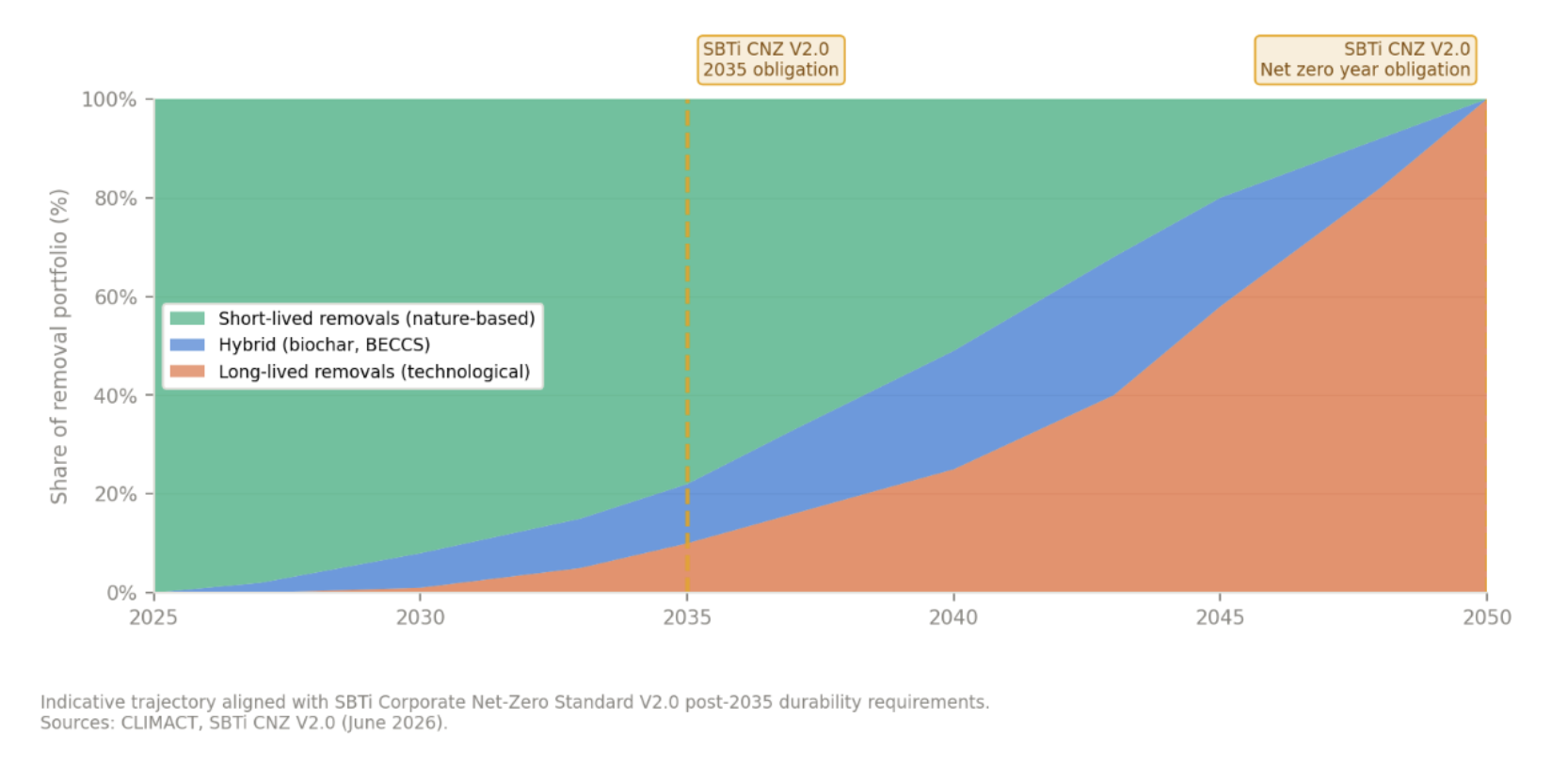
- Standards are tightening earlier than expected, with a specific 2035 threshold. The SBTi Corporate Net-Zero Standard V2.0, published June 2026, introduces a mandatory post-2035 requirement for large companies globally and medium-sized companies in high-income countries: from 2035 onwards, they must support eligible carbon removals equal to at least 1% of their total ongoing Scope 1, 2, and 3 emissions, rising linearly to 100% by their net zero target year (no later than 2050). This is a formal compliance obligation, not a recommendation. It applies well before 2050, and preparation must start now.
- Acting before 2035 can be valorized through the SBTi Ongoing Emissions Responsibility (OER) program. Companies can voluntarily take responsibility for a defined share of their ongoing emissions today, at three recognition levelsthrough verified mitigation outcomes or financial contributions. Doing so positions companies ahead of the 2035 mandatory threshold and signals climate leadership.
EU context and technologies evolve: credible removal credits become progressively more accessible.
The EU Carbon Removal Certification Framework (CRCF) is reshaping the European market. Adopted in 2024, the CRCF establishes a standardized certification mechanism for carbon removals, covering both land-based (forestry, soil carbon, biochar) and technological removals (direct air capture, enhanced weathering). Its ambition is to raise quality, reduce the risk of greenwashing, and channel demand toward verified, high-integrity projects. For European companies, this creates both a compliance signal and a sourcing opportunity.
The cost curve for technological removals (particularly direct air capture) is expected to decline substantially over the coming decade, though credible estimates vary widely. Securing supply agreements before demand pressure intensifies can ensure access to quality credits and represent a significant financial advantage.
What a robust removal strategy looks like
Engaging with carbon removals is not simply a procurement exercise. It is a strategic decision with long-term implications for cost, compliance, and corporate reputation. The companies best positioned for 2035 and beyond are those who are doing four things now:
- Quantifying their residual emission pathway. Understanding which emissions will remain after all feasible reductions, and by when, is the foundation for sizing a credible removal portfolio and anticipating the post-2035 obligation scale.
- Assessing quality across the removal spectrum, including durability. Not all carbon removals are equivalent. Permanence, additionality, co-benefits, monitoring rigor, and alignment with certification frameworks (CRCF, SBTi integrity criteria) all determine the long-term defensibility of the credits held. The distinction between short-lived and long-lived removals is increasingly a regulatory requirement, not only a quality preference.
- Assessing the integrity of the projects generating carbon removals. The same type of carbon removal can be issued from different projects worldwide. By conducting thorough due diligence, companies can ensure that the credits they purchase do no significant harm or support local communities. Open-source tools exist to support companies in assessing the integrity risks of certain projects (The Carbon Credit Quality Initiative – Scores)
- Building a diversified portfolio with forward visibility. Engaging in advance purchasing agreements, offtake contracts, or direct project partnerships allows companies to secure supply at competitive prices and build institutional knowledge before regulatory deadlines create demand spikes that inflate costs.
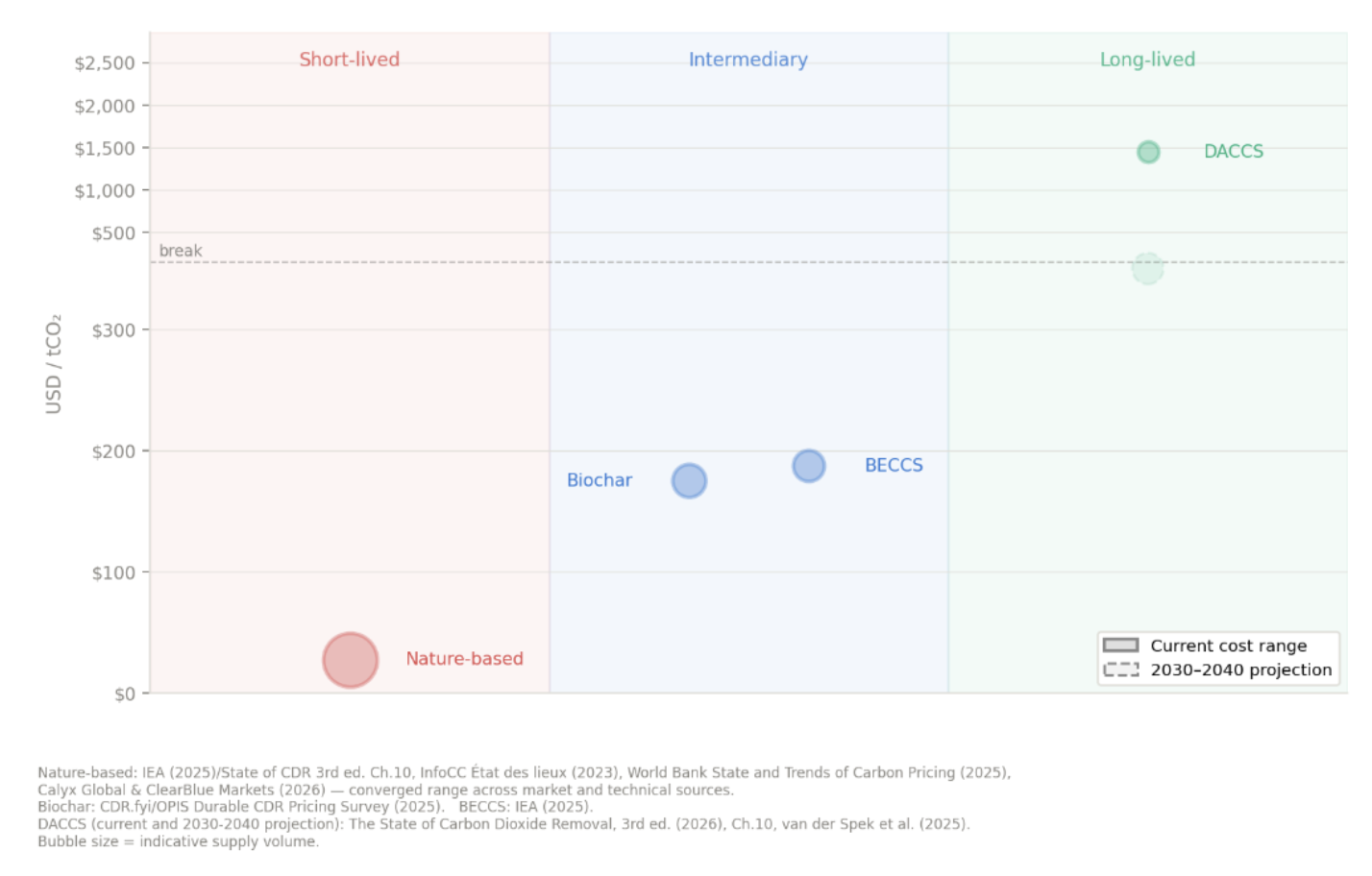
Portfolio diversification allows to deal with various prices, maturity and availability of the different solutions. A well-constructed removal portfolio combines short-lived (nature-based) removals (lower cost, near-term availability, permanence risks), hybrid approaches (biochar, BECCS), and long-lived (technological) removals (limited supply, less mature technology, higher cost, higher permanence, improving economics). Under the SBTi Corporate Net-Zero Standard V2.0, the portfolio mix is not just a strategic choice: from 2035, a minimum share of long-lived removals is required for long-lived GHG emissions (10%), rising to 100% at the net zero year. Building familiarity with the full spectrum now avoids being locked into a single approach when regulatory constraints narrow options.
How Climact can support you
Climact is an independent climate advisory firm specialized in supporting organizations developing net zero strategies, from emission accounting and target-setting to decarbonization roadmaps and carbon removal strategy.
Climact is not active in the development, purchase or sale of carbon credits, pursuing an independent role to ensure neutrality in our advisory activity and our recommendations.
On the specific question of carbon removals, we work with companies to:
- Define the residual emission boundary that will require removals, grounded in your sector’s decarbonisation potential and aligned with the SBTi Corporate Net-Zero Standard V2.0 or equivalent frameworks, including the post-2035 mandatory scale.
- Evaluate risks and opportunities associated with an OER-aligned approach for ongoing emissions before 2035. If relevant, support you structuring your OER approach, positioning your company ahead of the mandatory threshold and eligible for SBTi recognition.
- Evaluate removal options against quality and durability criteria, short-lived vs. long-lived removals, certification standards (CRCF readiness, SBTi integrity criteria), co-benefits, and reputational risk.
- Design a diversified portfolio strategy with a timeline aligned to regulatory milestones and your internal investment cycle, including forward purchasing to lock in costs before demand pressure builds.
- Translate technical complexity into board-level communication and public reporting, ensuring your claims are defensible, consistent with SBTi Corporate Net-Zero Standard V2.0 accounting rules, and credible to external stakeholders.
A note on the SBTi Corporate Net-Zero Standard V2.0 and the post-2035 requirement
Published in June 2026, the SBTi Corporate Net-Zero Standard V2.0 consolidates and replaces both the SBTi Near-Term Criteria and the first version of the Corporate Net-Zero Standard. The standard distinguishes between Category A companies (large companies globally and medium-sized companies in high-income countries) and Category B companies (smaller companies and medium-sized companies in lower-income countries). Category A companies face the most stringent requirements.
On carbon removals, the standard introduces two sets of provisions: (1) the optional Ongoing Emissions Responsibility (OER) recognition program, active now, which allows companies to voluntarily take responsibility for a defined share of their ongoing emissions through verified mitigation outcomes and other climate actions; and (2) a mandatory post-2035 requirement for Category A companies to support eligible carbon removals equal to at least 1% of total ongoing emissions from 2035, rising linearly to 100% by the net zero target year. A phased-in durability requirement applies: from 2035, at least 10% of covered long-lived GHG emissions must be neutralized with long-lived removals, increasing to 100% at the net zero year.
A note on the EU Carbon Removal Certification Framework (CRCF)
The CRCF, entered into force in 2024, is the first EU-level framework dedicated to certifying carbon removal activities. It distinguishes between three categories: permanent storage (geological or durable product storage), carbon farming (land-based biological removal), and carbon storage in long-lasting products. Certification is issued by independent bodies and must meet four core quality criteria: quantification, additionality, long-term storage, and sustainability. For European companies building net zero strategies, the CRCF provides a basis for sourcing credits that will hold up to regulatory and stakeholder scrutiny, an important differentiator from the broader voluntary market.