• EN
  • FR
  • NL
  • News & publications
  • Services
  • Sectors
    • Public Policies
    • Energy
    • Buildings
    • Transport & Mobility
    • Industry & Services
    • Agriculture & Land-use
  • Cases
  • About
  • Jobs
  • Contact us
  • News & publications
  • Services
  • Sectors
    • Public Policies
    • Energy
    • Buildings
    • Transport & Mobility
    • Industry & Services
    • Agriculture & Land-use
  • Cases
  • About
  • Jobs
  • Contact us
  • EN
  • FR
  • NL
Home - News

Can the low-carbon transition do without wood?

9 August 2021

The EU and our federal government have committed to reducing their greenhouse gas emissions by 55% by 2030 and to reach net zero emissions by 2050. The question addressed during the #Rencontresfilièrebois is to know what role the wood sector will have to play in this low-carbon transition.

Forests are at the center of climate issues since they are the first to suffer the consequences of climate change, but also because they must play a major role in capturing carbon from the atmosphere and storing it in solid form in the biomass and soils.Thanks to the prospective models we are developing at CLIMACT (see for example the Pathways Explorer for Belgium), a few key messages can be drawn:

The first is that such a transition can be achieved if and only if we decrease our energy consumption significantly. This strong decrease in energy consumption being possible via behavioral changes, building renovation, circular economy, functionality economy, etc.

Secondly, despite major efforts in all sectors of the economy, some emissions will not be eliminated. In particular, fugitive emissions related to agriculture such as methane emissions due to enteric fermentation, management of livestock effluents, or nitrous oxide emissions related to the spreading of nitrogen fertilizers whether mineral or organic.

To compensate for these residual emissions, natural carbon sinks, such as forests, grasslands, and wetlands, are essential. Our prospective models show that carbon sinks must at least double at the European scale by 2050. We will therefore have to somehow increase the area of forests and grasslands and preserve wetlands in order to increase our carbon sinks. It is possible to visualize the impact of certain levers of action that allow us to expand the forest and grassland areas. For example, the evolution of our diets, our agricultural practices, and our import/export policies influence the evolution of the areas dedicated to our crops, grasslands and forests.
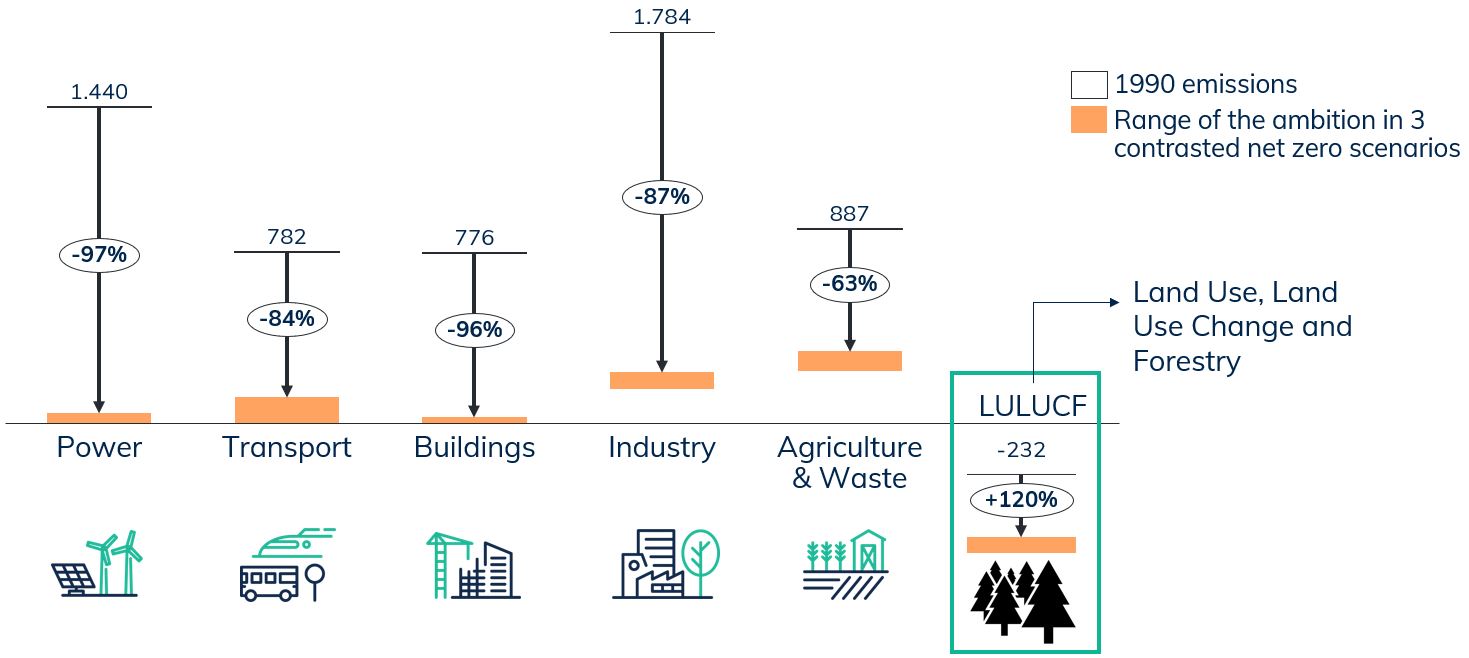
Figure: Carbon sinks must at least double on a European scale by 2050
Source : Data from 3 scenarios developped with the CTI tool : https://stakeholder.netzero2050.eu/ 

We also understand that the exploitation of our forests must be sustainable (harvest rate = renewal rate) but remains necessary when wood allows to substitute (1) more emission-intensive products (notably cement and steel in construction) and/or (2) fossil energies (bioenergy to valorize waste, branches, etc.).

Author : Charles Vander Linden

Share

Latest news & publications

  • News

    Understanding and managing energy and carbon exposure in an industrial context

  • Legal & Regulatory Advisory

    The Empowering Consumers for the Green Transition Directive: a new era for sustainability claims in the EU

  • News

    Tessenderlo Group: turning ESG reporting into strategic decision-making

More news

Get in touch with our experts

Contact us

Subscribe to our newsletter

Services

  • Prospective Studies
  • Strategy Consulting
  • Legal & Regulatory Advisory

Sectors

  • Public Policies
  • Energy
  • Buildings
  • Transport & Mobility
  • Industry & Services
  • Agriculture & Land-use
  • Twitter
  • LinkedIn
© 2026 Climact
  • Legal information
Powered by Shake

Subscribe to our Newsletter

We thank you for your trust and guarantee you that the only objective of our communication will always stay in line with our mission : increase energy sustainability, reduce impact on climate while adding value to our customers.

You can update your personal data at any time following the Update Profile link in the footer of any email you receive from us.

CLIMACT will use this information in compliance with the GDPR and our Privacy Policy.

Personal information
Invalid email
Invalid first name
Invalid name
Invalid company
Please choose a language

* Require field

You can change your mind at any time by clicking the unsubscribe link in the footer of any email you receive from us, or by contacting us at [email protected]. We will treat your information with respect. For more information about our privacy practices please visit our website. By clicking below, you agree that we may process your information in accordance with these terms.

We use Mailchimp as our marketing platform. By clicking below to subscribe, you acknowledge that your information will be transferred to Mailchimp for processing. Learn more about Mailchimp's privacy practices here.

An error has occurred
{{vm.alert_response}}
Error: This email is already subscribed.

By accepting, Google Analytics cookies will be installed to help us get statistics on how this website is being visited. Learn more ›