16 April 2025
Understanding how climate risk impacts your business is essential for resilience and long-term success. At Climact, we help organizations assess their exposure, quantify financial impacts, seize opportunities in the transition to a low-carbon economy, and navigate regulatory requirements.
Prepare for rising temperatures
2024 was the warmest year on record, with global temperatures exceeding 1.5°C for the first time over a 12-month period. Despite strengthened mitigation efforts – the EU has reduced net emissions by 37% compared to 1990 levels (EU, 2024) – even the most optimistic scenarios project at least 1.5°C of warming by 2030 globally. Belgium, warming at roughly twice the global rate, is no exception. Firms should assess their exposure to climate change-related risks and plan the investments needed to adapt to these impacts.
Avoid the rising costs of inaction
Rising temperatures are not just an environmental issue – they pose serious economic risks:
- Extreme weather events such as heatwaves, wildfires, and floods are becoming more frequent and intense, disrupting supply chains, damaging assets, and increasing operational costs.
- The financial consequences of inaction are staggering: the 2025 LA wildfires caused over $150 billion in damages, the 2024 Valencia floods cost more than €20 billion, and the 2021 Belgium-Germany floods led to €44 billion in losses.
- Across the EU, climate-related damages have amounted to €738 billion since 1980, with €162 billion incurred in just the last two years.
Seize opportunities in a changing climate
Shifting to a low-carbon economy presents both challenges and opportunities. Belgium’s goal of net-zero emissions by 2050, in line with the EU Green Deal, will require significant transformations across all sectors. Businesses will face regulatory shifts, new investment requirements, and evolving market conditions. But the transition also unlocks opportunities for innovation, efficiency, and sustainable growth. Those who adapt early can gain a competitive edge.
Comply with regulation
Climate risk disclosure is a key regulatory requirement, with the EU’s CSRD and Taxonomy providing essential frameworks for assessment and reporting. Businesses must comply to ensure transparency and resilience in a changing climate.
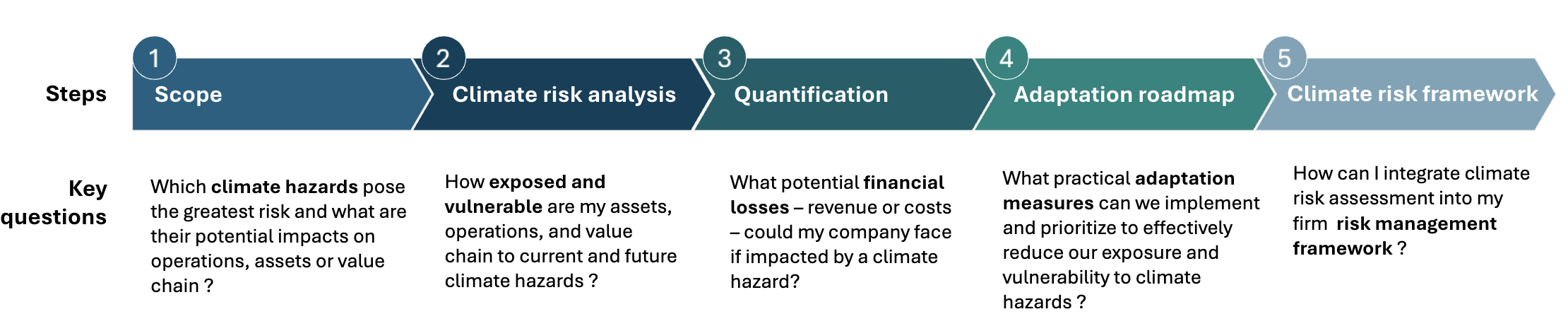
How to assess climate risks ?
We assess climate risks using a structured five-step approach, adapting it to each sector’s needs to provide the right solutions for different actors.
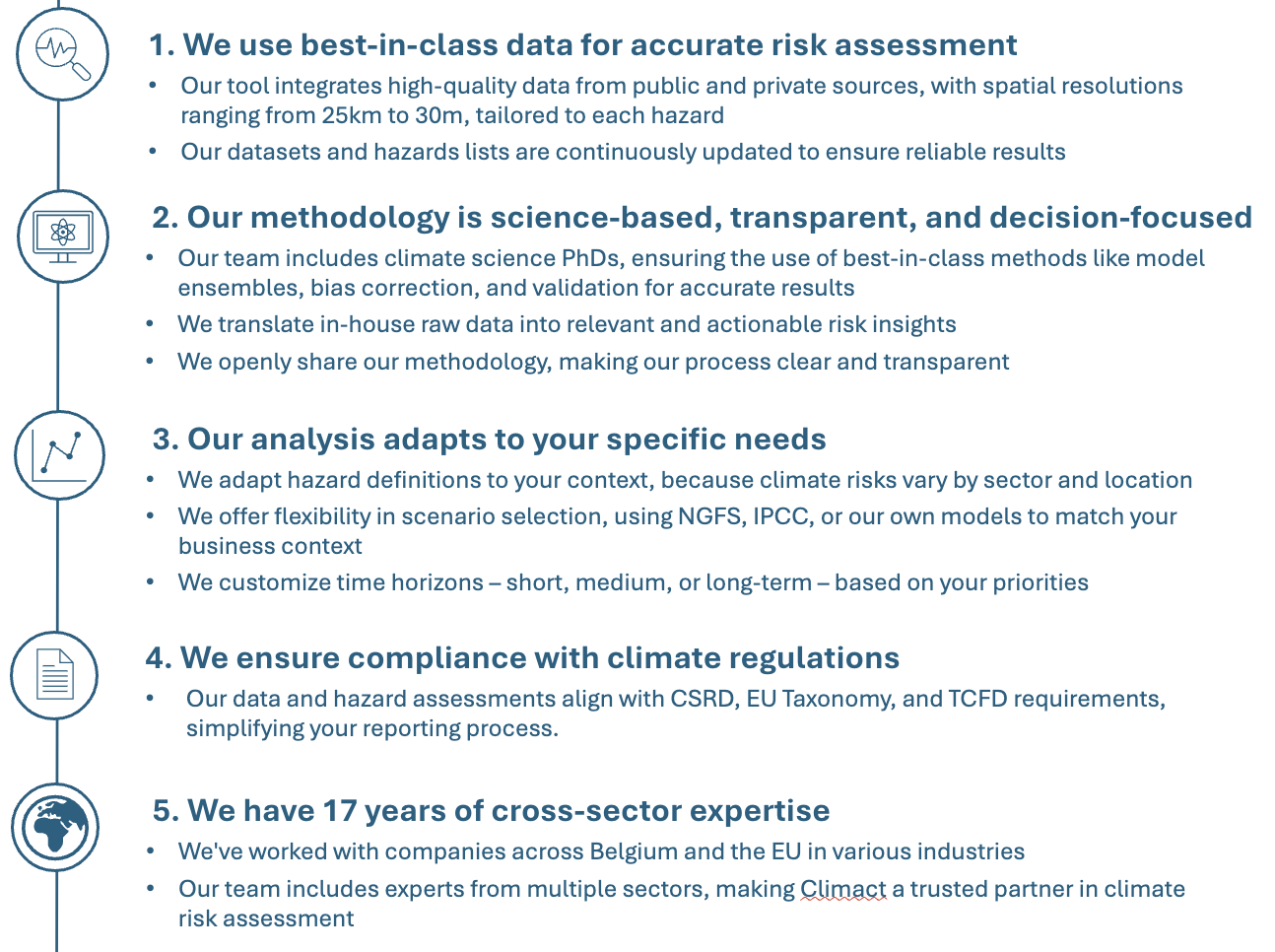
Why us ?
At Climact, we give you the means to act on climate change and the energy transition thanks to a good climate strategy. Don’t wait any longer, contact us !

Sources :
European Commission (EU, 2024). EU climate action progress report 2024. Retrieved from https://climate.ec.europa.eu/document/download/d0671350-37f2-4bc4-88e8-088d0508fb03_en
Network for Greening the Financial System (NGFS, 2024). NGFS long-term scenarios for central banks and supervisors. Retrieved from https://www.ngfs.net/sites/default/files/medias/documents/ngfs_scenarios_main_presentation.pdf
World Meteorological Organization (WMO, 2024). State of the Global Climate 2023. Retrieved from https://library.wmo.int/viewer/68835/download?file=1347_Global-statement-2023_en.pdf&type=pdf&navigator=1
European Environment Agency. (2024). Economic losses from climate-related extremes in Europe. Retrieved from https://www.eea.europa.eu/en/analysis/indicators/economic-losses-from-climate-related
Hinchliffe, E. (2025, January 13). Wildfires have destroyed an area larger than San Francisco and caused up to $150 billion in damage. Fortune. https://fortune.com/2025/01/13/wildfires-destroy-area-larger-than-san-francisco-damage-up-to-150-billion/